
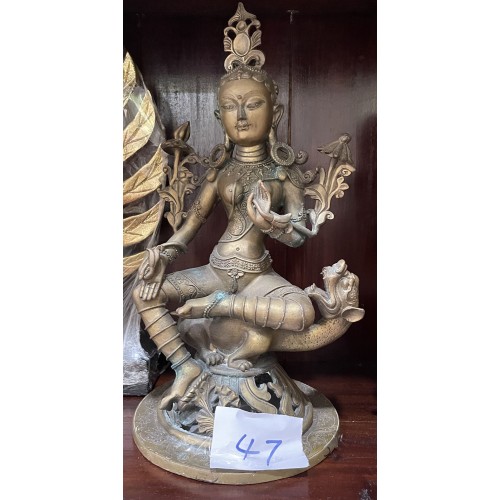
The Green Tara (Sanskrit: Shyamatara; Tibetan: Sgrol-ljang) was believed to be incarnated as the Nepali princess. She is considered by some to be the original Tara and is the female consort of Amoghasiddhi, one of the “self-born” buddhas. She is generally shown seated on a lotus throne with right leg hanging down, wearing the ornaments of a bodhisattva and holding the closed blue lotus (utpala).
The White and Green Taras, with their contrasting symbols of the full-blown and closed lotus, are said to symbolize between them the unending compassion of the deity who labours both day and night to relieve suffering. Under the influence of Tibetan Buddhism the different forms of Tara multiplied to a traditional 108. Tibetan temple banners frequently show 21 different Taras, coloured white, red, and yellow, grouped around a central Green Tara. The figure of the “self-born” Amitabha Buddha is often shown in her headdress, as she, like Avalokiteshvara, is considered to be an emanation of Amitabha.
In her ferocious, blue form, invoked to destroy enemies, she is known as Ugra-Tara, or Ekajata; as a red goddess of love, Kurukulla; and as a protectress against snakebite, Janguli. The yellow Bhrikuti is an angry Tara, with frowning brows.
Goddess Green Tara
- Language: Chinese
- Classification: Goddess Green Tara
- Availability: In Stock
Available Options
Tags: Goddess Green Tara